.png)
AI Transforming Digital Marketing Strategies in 2026

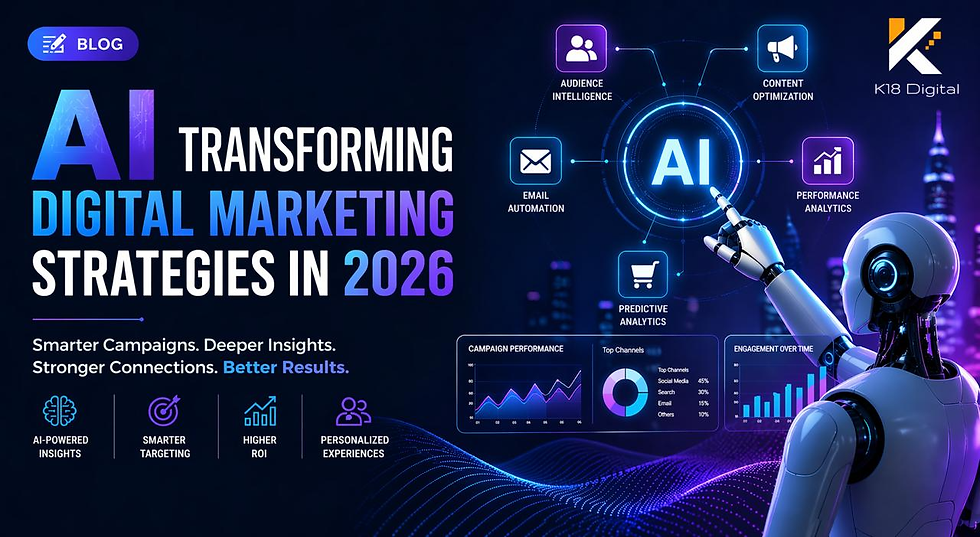
Ever noticed your ads getting smarter, but your results not improving? That’s the trigger. Businesses are spending more but still struggling to keep pace with rapidly evolving tools. The real issue isn’t effort, it’s adaptation. So what’s actually changing in 2026, to know how AI is Transforming Digital Marketing Strategies in 2026, and why are some brands scaling while others stall?
How AI is Transforming Digital Marketing Strategies in 2026
Artificial Intelligence in marketing means systems that analyze data, predict behavior, and automate decisions in real time. In 2026, it has moved beyond being just a support tool; it’s now central to how campaigns are built and scaled.
Instead of manually setting up campaigns, AI identifies patterns, predicts intent, and adjusts strategies instantly. For businesses working with a digital marketing agency in Gurgaon, this means shifting from execution-heavy models to more strategic, insight-driven growth.
Search Changes
Search is no longer about typing keywords and browsing links. Users today expect immediate, accurate answers, especially with AI-driven search interfaces becoming mainstream.
This shift is most visible among users aged 25–45, who increasingly rely on conversational queries and voice searches. As a result, traditional SEO tactics are evolving. Modern SEO companies now focus less on individual keywords and more on building topical authority and structuring content in a way that AI systems can easily interpret.
If your content isn’t structured clearly, it may never appear in AI-generated answers, even if it ranks well.
Content Personalization
One-size-fits-all content is quickly losing effectiveness. AI enables brands to tailor messaging based on user behavior, demographics, and intent, often in real time.
For instance, a young professional in their late 20s might see messaging focused on affordability and quick results, while a business owner in their late 30s is shown content emphasizing scalability and ROI. This level of personalization creates stronger engagement because it feels relevant rather than generic.
Brands that fail to adapt here often see declining conversion rates, even if their traffic remains stable.
Ad Automation
Paid advertising has undergone a significant transformation with AI. Campaigns are no longer manually optimized at every step. Instead, AI continuously learns from performance data and adjusts bidding, targeting, and creatives automatically.
A Google Ads agency in Gurgaon today plays a different role; it’s less about running ads and more about guiding the system with the right inputs. However, relying solely on automation can backfire if the underlying strategy is weak.
Many businesses struggle with rising ad costs because they depend too heavily on automation without clearly defining their audience or goals. The most effective approach combines human strategy with AI-driven execution.
Social Intelligence
Social media marketing has become more predictive than reactive. AI tools now analyze engagement patterns, sentiment, and content performance to identify what resonates even before a post goes live.
For a LinkedIn marketing agency, this is particularly powerful in B2B scenarios. Instead of experimenting blindly, marketers can create content backed by data insights, leading to higher-quality leads and better engagement.
This shift reduces guesswork and replaces it with informed decision-making.
Development Impact
AI’s influence extends beyond marketing into product development. A mobile app development company in Gurgaon now integrates AI to enhance user experiences through personalization and predictive behavior tracking.
For example, apps targeting younger audiences often use AI to recommend content dynamically, while apps built for professionals focus on efficiency and automation. This alignment between product experience and marketing strategy ensures consistency across the user journey.

Customer Journey
The traditional marketing funnel is evolving into a more fluid, AI-driven journey. Instead of moving linearly from awareness to conversion, users now interact with brands across multiple touchpoints influenced by predictive insights.
AI helps anticipate user needs, deliver relevant messaging at the right moment, and create seamless transitions between stages. This makes the overall experience feel intuitive rather than forced.
As a result, marketing becomes less about pushing messages and more about guiding decisions.
Future Trends
Looking ahead, AI is pushing marketing toward a more proactive approach. Instead of reacting to demand, businesses are beginning to predict it.
We’re also seeing the rise of conversational interfaces, where users interact with brands through chat-based experiences rather than traditional websites. At the same time, zero-click environments are growing, meaning users often consume information without ever leaving the search platform.
This raises an important shift - visibility is no longer just about rankings, but about being present where decisions are made.
Conclusion
AI is not replacing marketers - it’s reshaping how marketing works. Businesses that adapt early will gain a clear advantage in both visibility and conversions. The key lies in combining strategy with intelligent systems to stay relevant, much like forward-thinking brands are already doing.


Comments