.png)
Digital Transformation for SMEs in India: The Maturity Gap Most Businesses Miss

Most Indian SMEs believe they've gone digital. Here's where they actually sit — and the step-by-step path to real digital transformation
Ask most Indian SME owners whether they've "gone digital" and the answer is yes.
They'll point to their WhatsApp Business account. Their Tally installation. The QR code on the counter. The Instagram page that was last posted on in February. This isn't digital transformation. This is digital decoration.
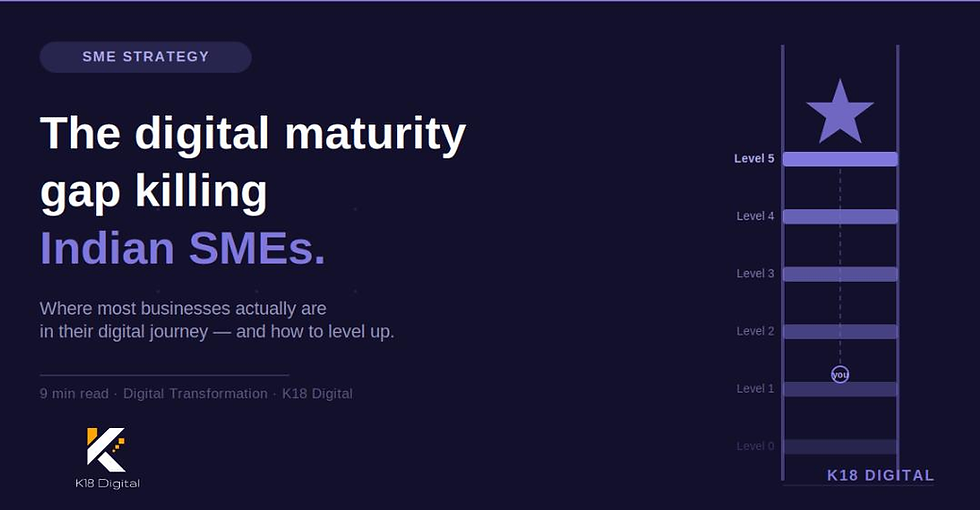
Real digital transformation for SMEs in India does not happen in a single project. It moves through five distinct maturity levels — and most businesses are stuck at Level 1 without realising it.
The gap between where most Indian SMEs believe they are and where they actually need to be is not a technology problem. It's a clarity problem — and it's costing businesses significantly more than they realise.
The Digital Maturity Ladder: Where Do You Actually Stand?
Digital maturity isn't a binary — you either have it or you don't. It's a progression. And most businesses are further back on that progression than they admit to themselves.
Here's the framework we use with every SME we work with:
Level | Stage Name | What It Looks Like |
Level 0 | Analogue | Paper records, phone calls, cash-only. No digital tools in the business workflow. |
Level 1 | Basic Digital | WhatsApp, email, spreadsheets, Tally. Digital communication but manual operations. |
Level 2 | Digital Operations | Cloud accounting, UPI/digital payments, basic CRM, a functional website. |
Level 3 | Connected Systems | Integrated applications — CRM talks to accounting, leads flow into pipelines automatically, operations tracked in real-time. |
Level 4 | Data-Driven | Custom dashboards, performance analytics, decisions made from data not gut feel. Customer intelligence actively used. |
Level 5 | AI-Augmented | Predictive analytics, AI-assisted customer service, automated personalisation at scale. |
📊 Where Indian SMEs actually sit Based on data from NASSCOM and the Ministry of MSME, approximately 62% of Indian MSMEs operate at Level 0 or Level 1. Only 12–15% have reached Level 3 (connected systems). Fewer than 5% operate at Level 4 or above. The businesses growing at 2–3× their category average are almost uniformly at Level 3 or 4. |
The Cost of Staying Where You Are
Digital maturity gaps have direct financial consequences. They're just spread across enough line items that no single one looks decisive — which is why most SMEs tolerate them longer than they should.
At Level 0–1: The manual labour premium
Businesses at the earliest maturity levels are paying a human to do what software does for ₹500/month. Data entry, appointment scheduling, payment reconciliation, follow-up calls — tasks that are fully automatable are consuming staff hours that cost 20–40× more than the tools that would replace them. The kicker: manual processes also introduce errors that cost even more to fix.
At Level 1–2: The visibility gap
Business owners at this stage make most decisions from memory and instinct. They don't know which product line is most profitable. They don't know which marketing channel is generating their best customers. They don't know whether this month is better or worse than last month in any granular sense. This isn't wisdom — it's expensive guesswork.
At Level 2–3: The integration tax
Businesses that have adopted tools but haven't connected them pay a hidden tax: the hours spent bridging systems manually, the errors introduced by duplicate data entry, the leads that fall through the gap between a website form and a sales follow-up. Disconnected tools are often worse than fewer tools, because they create the illusion of digital maturity without the operational benefit.
At Level 3–4: The decision lag
Even businesses with connected systems often lack the reporting layer that turns data into decisions. They have the data — it lives in their CRM, their accounting software, their ops platform — but nobody has built the dashboard that surfaces the number the owner actually needs to see every Monday morning. The result: decisions made a week after they should have been.
The Progression Plan: How to Move Up the Ladder
The mistake most SMEs make when they decide to "go digital" is trying to jump from Level 1 to Level 4 in one project. This consistently fails — the change is too large, the organisation isn't ready, and the investment is too concentrated in one unproven direction.
Effective digital transformation for SMEs in India is not a ₹50-lakh overhaul — it is a disciplined progression, one level at a time, with measurable ROI at each stage before investing in the next.
The businesses that succeed move one level at a time, with clear ROI at each stage before investing in the next.
Level 0 → 1: The baseline (₹0–₹5,000/month)
· Google Workspace for email, docs, and shared storage
· WhatsApp Business with a complete profile
· UPI and digital payment acceptance
· A spreadsheet — maintained consistently — for customers, leads, or inventory
Time to implement: 1–2 weeks. This is non-negotiable. If you're still at Level 0, this is the only thing to think about right now.
Level 1 → 2: Digital operations (₹5,000–₹20,000/month)
· Cloud-based accounting — Zoho Books or Tally on Cloud
· A basic CRM — even a simple one — to track every lead and customer interaction
· A real website — not a social media page, an actual domain with your services and contact information
· Digital invoicing — automated, trackable, professional
Time to implement: 4–8 weeks. The biggest resistance at this stage is data migration — getting existing records into new systems. It's worth the short-term pain.
Level 2 → 3: Connected systems (₹20,000–₹60,000/month or a one-time custom build)
· CRM integrated with your website — every enquiry becomes a tracked lead automatically
· Accounting integrated with payments — every transaction reconciled without manual entry
· Marketing automation — follow-up sequences triggered by customer behaviour, not someone's memory
· Operational software that matches your specific workflow — often the point where off-the-shelf tools run out and custom development begins
This is the level that creates compounding advantage. The gap between a Level 2 and Level 3 business is felt by every customer who interacts with them.
Level 3 → 4: Data-driven decisions (custom build + analytics layer)
· A custom reporting dashboard that surfaces the 5–7 metrics the owner needs to see every week
· Customer segmentation — knowing which customers are most valuable and why
· Attribution — knowing which marketing activities are generating your best leads
· Forecasting — using historical data to make forward-looking decisions with confidence
This isn't about exotic technology. It's about making what you've already built speak to you.
The Most Common Reason SMEs Get Stuck
It isn't budget. Most of the tools required to reach Level 3 cost less per month than a part-time staff member.
It isn't awareness. Most SME owners know they need to do more.
It's the belief that the current way is "good enough for now" — and a fear that digital transformation is a large, disruptive, expensive project that will absorb months of management attention.
The fastest path to meaningful digital transformation for SMEs in India is to stop asking "how do we transform?" and start asking "what is the one process costing us the most right now — and how do we fix it in 30 days?"
The businesses that move fastest are the ones who reframe the question. Instead of "how do we transform our business?" they ask "what is the one process that is costing us the most right now, and how do we fix it in the next 30 days?"
That answer is almost always a specific, bounded problem — a follow-up process, an invoicing workflow, a lead management gap — that can be addressed with a focused tool or a short custom build. Not a transformation. A fix. And then the next fix. And then the one after that.
Where are you on the digital maturity ladder — and what's the right next step? At K18 Digital, we help SMEs assess their current digital maturity and build the right next layer — custom apps, integrations, or connected systems — without the cost or disruption of a full transformation project. k18digital.com | connect@k18digital.com | +91 98992 77516 |


Comments